
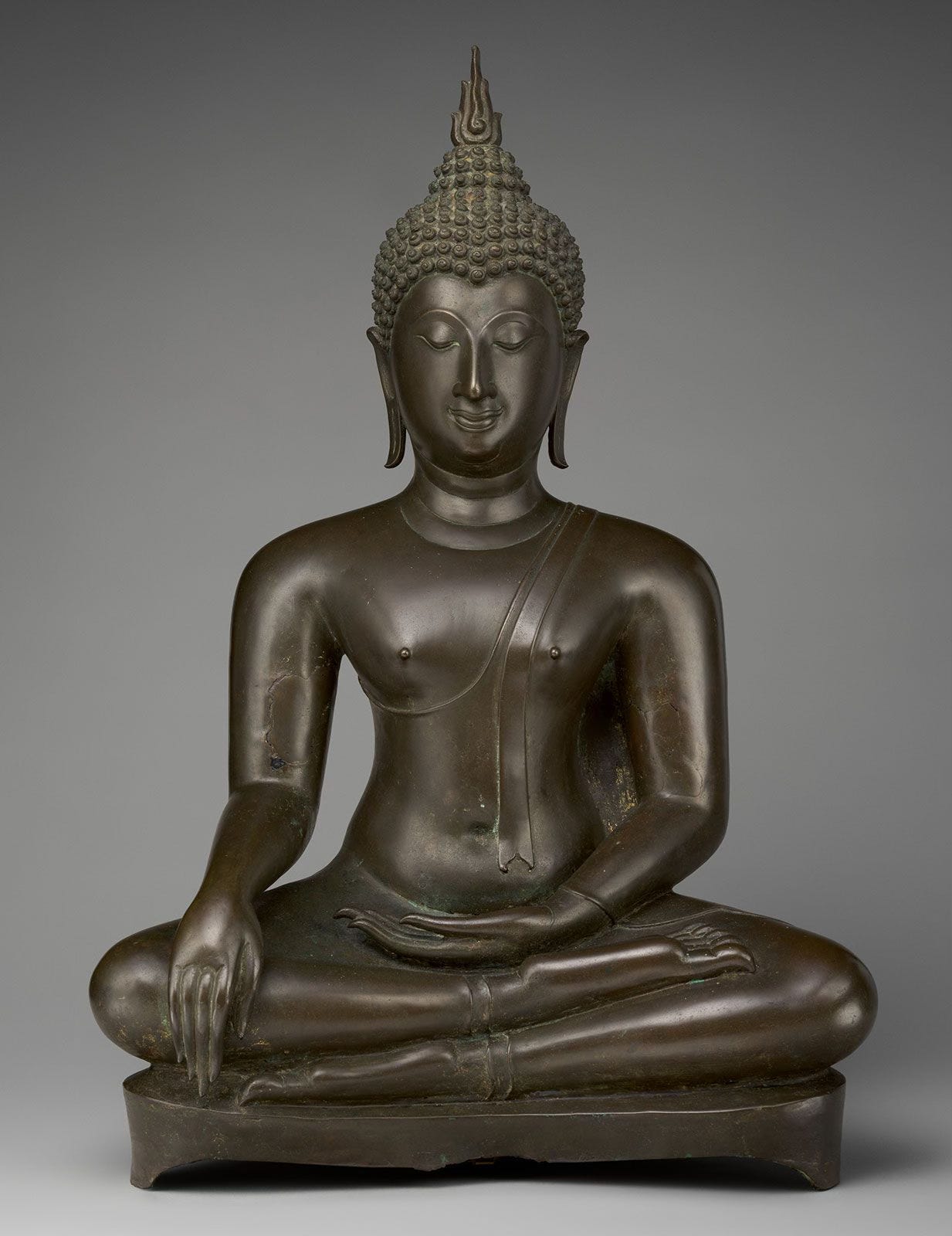
I’m not a Buddhist, nor did I grow up in any Buddhist tradition. But I have always been fascinated by it. These are some reflections based on notes I made during a retreat last year.
At the heart of Buddhist thought is the denial of substance. How do I describe myself? I might point to my body, my thoughts, my memories, my habits. But is there a “me” that exists somewhere behind all these characteristics, some essential underlying core that would remain if you stripped everything else away?
Or think about a table. We can describe its color, its hardness when we touch it, the sound it makes when we knock on it. But is there a “table” above and beyond these properties, some inner essence that makes it truly, permanently a table?
According to Buddhist thought, this kind of inherent, fixed existence simply isn’t there. What we think of as solid things are actually collections of characteristics and relationships that are subject to constant change, a continuous series of becoming.
This is reminiscent of British empiricist philosophers like John Locke and David Hume, who made similar arguments about substance. Hume even applied this logic to causation itself: do we actually perceive one thing causing another, or do we just see one event followed by another? Just as we never find an inherent “self” when we look inside, we never actually see causes, only sequences of events.
The concept of impermanence in Buddhism is related to this absence of fixed essence. Imagine you meet someone and feel a strong attraction. In that moment, you experience this person as a solid entity, someone in whom your future happiness resides. But she isn’t a fixed entity, nor are you. More importantly, the attraction itself isn’t some absolute truth about the universe. It’s a relationship between two sets of characteristics at a particular moment in time, in a particular place. You might lose the attraction after getting to know her better, or after getting to know yourself better. The happiness you imagined finding “in her” might vanish, or even transform into suffering if you insist on pursuing it still.
Neither you nor she nor the attraction nor the happiness you seek can remain independent of everything else. They’re all contingent, arising from conditions, changing as conditions change. The fixed, solid, graspable thing we’re looking for doesn’t exist. This is true of all experiences, pleasant and unpleasant.
Often things don’t turn out as we expected them to, and that creates dissatisfaction. Sometimes they turn out exactly as we wanted, and still we find ourselves wondering if this is all there is.
We experience a pleasant state, and somewhere in the back of our minds we know this feeling can’t last in quite this form. When we try to prolong it, we end up destroying the very thing we tried to make permanent. This is the fundamental unsatisfactoriness of conditioned existence, what the Buddha identified as dukkha, the first of his four truths for the noble.
What causes this? The second truth identifies ignorance as the root. We attribute to things qualities they don’t have. When we’re attracted to something, we exaggerate its positive qualities and overestimate how happy it will make us. When we’re repulsed by something, we magnify its negative qualities and overestimate how miserable it will make us. We fail to see things as they really are. From this ignorance arises craving, the immediate cause of suffering.
It is often said that the Four Noble Truths were inspired by the Indian medical system, with dissatisfaction viewed as a disease. The possibility of cure is just as important as its diagnosis: it makes a world of difference whether a physician says “there is no known cure” or “there is a cure, and here’s what it involves.” The existential equivalent is the third truth: Nirvana is possible.
Nirvana literally means “blowing out”, but it isn’t the same as annihilation. Indeed, the Buddha described the desire for nonexistence as another craving. At the same time, he suggested that attempts to describe its nature would only misrepresent it.
In Buddhist meditation, you’re asked to observe your thoughts and emotions without judging them or getting swept away by them. As you stop feeding the flames through identification and attachment, the false sense of a fixed self begins to dissolve. You start seeing things as they actually are, and in that clarity there’s peace.
The path to this state, the fourth truth, involves ethical living, the search for knowledge, and practices of mindfulness.
I broadly agree with all of this, with one clarification: I think most of us spend much of our time in a kind of inertia, experiencing neither dissatisfaction nor happiness. This observation might not necessarily contradict Buddhism.
What I do find difficult to accept are certain elements of traditional Buddhist cosmology. In classical Buddhism, the vast disparities we see among people are explained through karma and rebirth. Why is one person born with a certain natural ability while another struggles? Why does one child grow up in comfort while another faces poverty and hardship? The traditional answer involves actions from past lives creating the conditions for this one. Traditional cosmology also includes realms we can’t perceive: worlds of demigods, hungry ghosts, various heavens and hells.
The problems these doctrines were meant to solve, like explaining inequality, can be addressed through other frameworks. For instance, a more creative interpretation of “past lives” would be to see them as the lives of our ancestors. Their experiences do, in a sense, transmit to us. Our genetic heritage accounts for differences in characteristics and capacities. The circumstances of where and when we’re born determine the privileges and hardships we encounter. The cultural knowledge, suffering, and wisdom of previous generations shape the world we inherit.
We find ourselves as participants in a vast chain of events that is both part of ourselves and outside us, stretching back through our lineage and forward through the impact we have. This interpretation also helps address a problem that has plagued Buddhist philosophers: if there is no persistent self, then who is reborn? As for the ethical implications, they remain largely similar.
In the end, I conclude that the Four Noble Truths (suffering exists, it has a cause, liberation is possible, there’s a path) and the Four Seals of Dharma (all compounded things are impermanent, all conditioned experiences involve unsatisfactoriness, all phenomena are empty of inherent existence, Nirvana is peace) are among the most profound ideas humanity has produced.
Keep Reading:
→ The Inescapability of Altruism
→ Solving the Trolley Problem and Other Moral Dilemmas
→ Michael Shermer on Morality and Science (podcast)
Other Projects:
→ Universal Open Textbook Initiative (free, multilingual textbooks)
→ Aesthete (Curate your culture — iOS app)