
When we don’t fully understand something, or when our reason is arrested by our emotions and temperament, we tend to see in things a certain hardness. Hidden essences behind appearances, something substantial underneath the surface. As our knowledge deepens, that core begins to disappear. We find that it was never there. It was placed there by our own projections and needs. What remains once it’s gone is merely real, sometimes stranger than what we imagined, sober and perhaps less exciting. The projected layer, the imagined substance, turns out to have added nothing. It was superfluous from the start.
The Madhyamaka philosophers understood that attachment to essence was a form of clinging. It was existential, not merely intellectual. Which is why argument alone does not dislodge it. Ignorance can get corrected. What is harder to correct is this need for the essence to exist. These are different problems. Conflating them is why the same mistake gets made, even by intelligent people, generation after generation.
This pattern runs through the history of ideas, in areas as diverse as we can imagine. When we feel a sense of reverence or fear with respect to an object or person, we are overwhelmed by the possibility of something that transcends the physical. Eventually, if it is seen, encountered, desacralized, or in some other way truly known, we discover the extent to which our own projections gave it that mysterious, indescribable quality. The nation state is individuals following rules; there is no “nation” or “authority” somewhere at the heart of a land or a building. Scholastic substantial forms, the inner essences that made things what they were, dissolved into particles and motion with the rise of early modern philosophy. In contemporary fundamental physics, elementary particles are viewed not as solid bits of matter but as excitations of underlying fields. At the bottom of the world, there is no hard ground of the kind our intuition demands.
Perhaps the most interesting example of this is David Hume’s view on causation. Hume observed that when we watch one event follow another, reliably and repeatedly, we see only that one event follows another. We never see the necessity that binds them. We never observe a “cause.” The compulsion we feel, the sense that the second event had to follow, is something we bring to the experience. It seems simple once stated, and aligns with what we have learned over the years in modern physics. Yet the mind finds it difficult to accept.
Kant read Hume carefully enough to call him the one who woke him from his dogmatic slumber. But he then spent his career reestablishing causation, not as a feature of things in themselves, but as a necessary condition for the possibility of objective experience. The essence was still preserved. This is presented in the history of philosophy as one of its great achievements, and indeed the technical apparatus is impressive. But at its root it is a rescue operation, rather than the product of a free discovery. The projected layer was threatened, so it was relocated to somewhere safer. That Kant’s version is more sophisticated than the naive view makes it more impressive, but not less symptomatic.
This was one of Buddhism’s great discoveries: objects in the world lack the hard, fixed core that we keep projecting onto them. “Existence precedes essence,” as the existentialists put it.
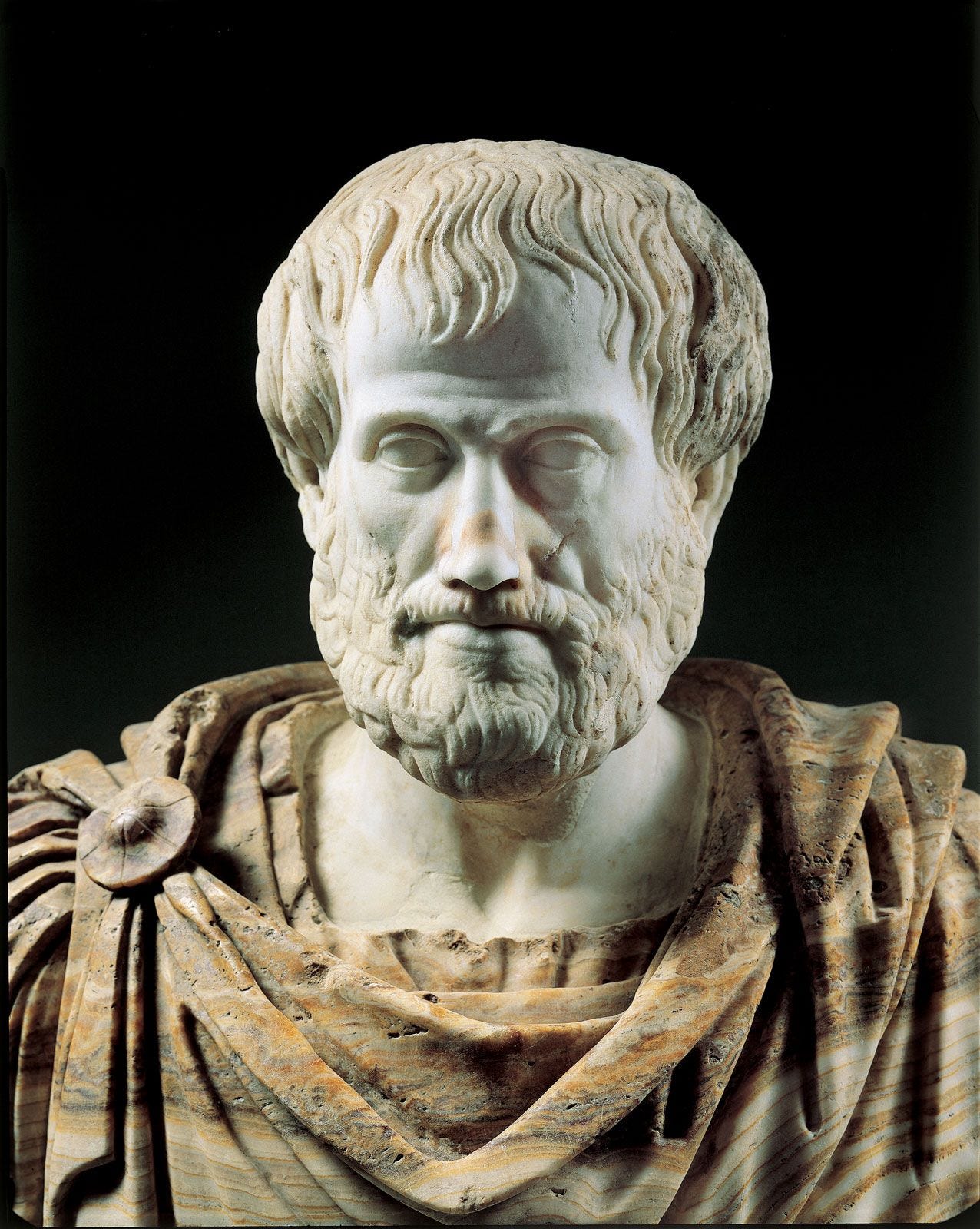
Even in our own times, when I look at how people conceptualize questions regarding whether AI systems are truly conscious, whether they genuinely understand, whether experience and emotions are emerging in them, and whether they have values and character, I often see the same underlying philosophical compulsion to find essences and irreducible qualities, a hidden presence that either is or isn’t there. The essence is threatened by an account that seems deflationary, so it is relocated to the inner theater of subjective experience, somewhere no external description can reach. The shadow of Aristotle refuses to budge.
The answers, when they come, will follow the familiar pattern. What will turn out to be real are the processes and their consequences: what we can discover about what the systems do and what behaviors we can shape and constrain. We have faced versions of this before. When powerful corporations emerged and threatened the interests of people, what resolved the practical question was law and regulation, aligning behavior with broader interests, because that is what was actually there. AI will likely be no different. The question of whether something genuinely understands will give way to the question of what can be said about what it does and whether that can be directed toward good ends. The problems may be different in scale, but no new substance will be found.
The history of ideas contains a long, only partially successful struggle against our compulsion to add layers that aren’t there. The layers feel like depth. They feel meaningful and even mysterious. But they are superfluous.
Continue Reading:
→ Every Problem Is a Prediction Problem
→ Michael Huemer: Nature of Knowledge, Foundations of Morality (podcast)
Other Projects:
→ Universal Open Textbook Initiative (free, multilingual textbooks)
→ Aesthete (visualize your taste — iOS app)
The heart emoji example came to mind reading this. Someone replies with ♡ and immediately you're constructing an entire inner world behind it — they must like me, there must be something there. But maybe it's just how they type. The "essence" was never in the emoji. It was placed there by the need for it to be there. That felt like a very ordinary, very common version of exactly what you're describing.
Your AI consciousness point also made me think about how we judge understanding in other people. In practice, we never access anyone's inner experience directly. We just check whether their responses track with what we said — if the reply is on topic, we call it understanding; if it drifts, we say they didn't get it. The test is behavioral, not essential. Which means the way we evaluate AI and the way we evaluate each other may be structurally closer than the consciousness debate usually admits.